


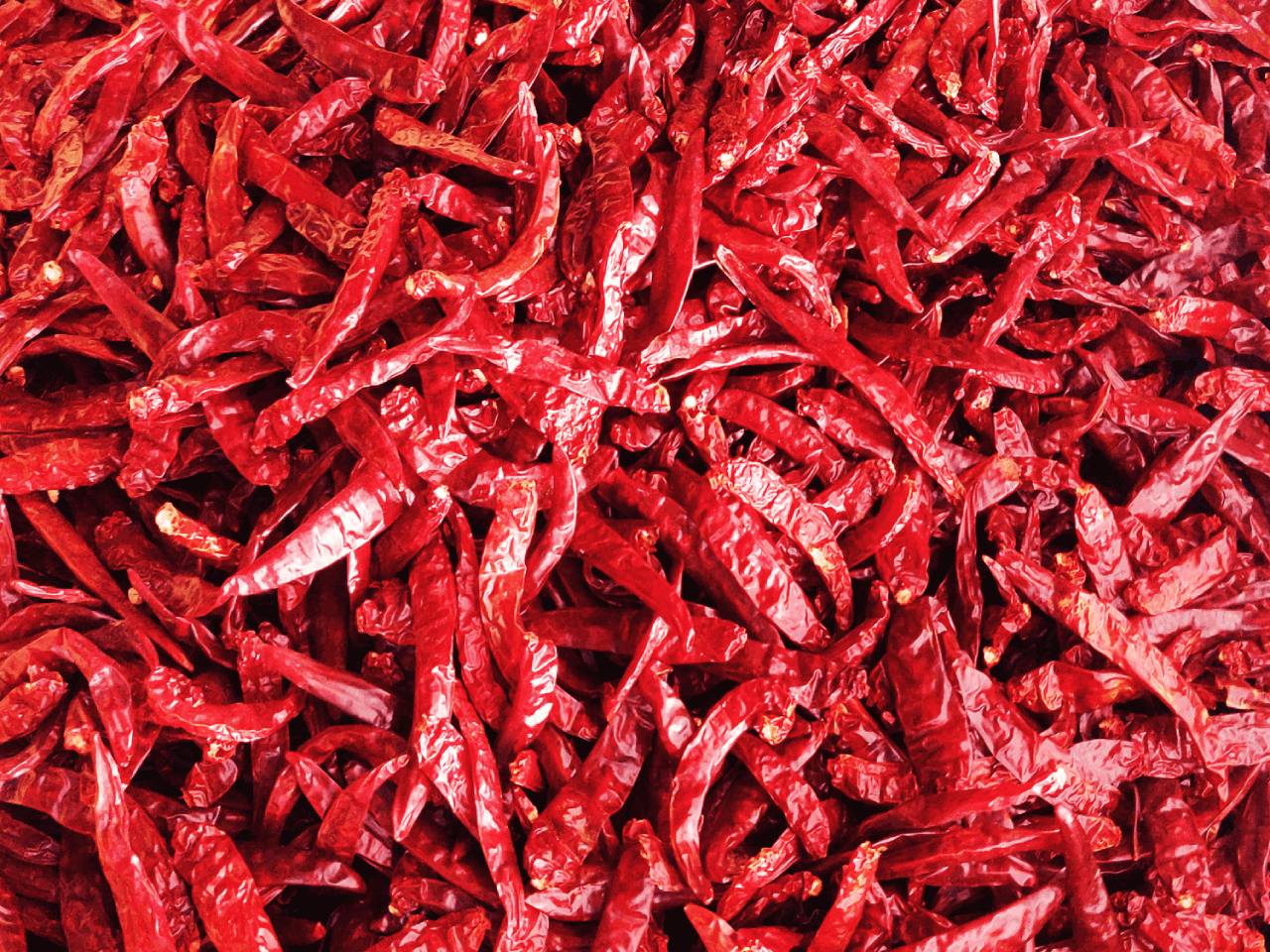
If you buy chilli for a living, you already know the format matters as much as the flavour. Whole dry red chilli and crushed chilli come from the same plant, but once they hit a production line, they behave quite differently. One gives you room to shape the raw material yourself; the other saves you a step and gets straight to work.
So which is the smarter buy? It depends on what you’re making, how your facility is set up, and how much control you want over texture and colour. Let’s walk through the real differences.
WHAT WHOLE DRY RED CHILLI ACTUALLY GIVES YOU
Whole dry red chilli is exactly what it sounds like — dried pods, sold whole, sometimes with the stem still attached depending on what the buyer asked for. Drying locks in colour, aroma, and heat while removing enough moisture to keep the product stable on a shelf.
The real appeal for industrial buyers isn’t the chilli itself — it’s the flexibility. Because nothing’s been ground down yet, you decide what happens next: clean it, sort it, mill it fine or coarse, blend it with another variety. The raw material is still yours to shape.
That’s why whole chilli shows up in so many end products: powders, flakes, pastes, pickles, seasoning blends, snack coatings, even oleoresin extraction. If your facility has its own milling setup, whole chilli lets you produce more than one output from a single incoming batch — hard to do once the pods have already been broken down for you.
AND WHAT ABOUT CRUSHED CHILLI?
Crushed chilli — chilli flakes, in a lot of applications — is made by mechanically breaking the dried pods into smaller pieces. It’s coarser than powder, and depending on spec, you’ll get a mix of flake, seed, and skin in the bag.
The advantage is speed. Someone’s already done the grinding, so the material drops into a formulation the moment it arrives. Manufacturers can also request a specific particle size — fine for a seasoning blend, chunkier for visible chilli on a pizza topping or in a jar of pickle.
You’ll typically find it in seasonings, sauces, marinades, ready meals, snack coatings, and foodservice products — anywhere a bit of visible red heat adds appeal to the finished item.
WHERE THE TWO ACTUALLY DIFFER
| Factor | Whole Dry Red Chilli | Crushed Chilli |
|---|---|---|
| Processing flexibility | Very high | Moderate |
| Further grinding needed | Yes, if required | Usually not |
| Particle-size control | Set by the buyer | Set by the supplier |
| Visual chilli presence | Low until processed | High |
| Extra processing required | More | Less |
| Storage flexibility | Generally easier | Needs closer attention |
| Best fit for spice mills | Excellent | Good |
| Best fit for ready seasoning use | Needs further work | Excellent |
| Quality checks | Easy at the pod level | Needs particle-level checks |
PROCESSING FLEXIBILITY
Whole chilli wins when flexibility is the priority. You can run one batch into powder and another into flakes from the same lot — useful if your customer base has mixed needs. Crushed chilli skips that decision entirely; you already know the particle size you’re getting, so there’s one less step before production. Pick whole chilli if you want to control the grind, crushed if you just want it ready to go.
CONTROL OVER PARTICLE SIZE
Particle size affects how chilli disperses in a recipe, how it looks on shelf, and how quickly its flavour releases. Whole chilli lets you dial this in with your own equipment. Crushed chilli arrives to spec, which is convenient if consistency matters more than customisation. Either way, your purchase spec should cover particle size, seed content, moisture, colour, pungency, foreign matter limits, microbiological requirements, and packaging — not just “whole” or “crushed.”
COLOUR AND APPEARANCE
Colour sells. Whole pods give processors the chance to select and treat the material however suits the final product best. Crushed chilli, on the other hand, puts the chilli front and centre — visible red flakes in a seasoning or sauce send a different message than a smooth powder does. The actual shade still comes down to variety, growing conditions, drying method, and storage along the way.
PUNGENCY AND FLAVOUR
Heat comes from capsaicinoid levels; flavour and aroma trace back to variety and how the chilli was processed. Whole chilli gives you more room to blend varieties — say, pairing a high-colour chilli with a hotter one for a specific balance. You can still blend crushed chilli, but you’re working with an ingredient that’s already been through more hands. For custom spice blends, whole chilli usually gives you a longer leash.
QUALITY INSPECTION
Whole pods are simple to inspect visually — colour, size, damage, mould, insect activity, moisture, stem content, all easy to spot before processing. Crushed chilli needs a different kind of scrutiny: particle distribution, seed-to-flake ratio, contamination, and microbial quality at a product level rather than a pod level. Neither format gets a free pass on lab testing or supplier verification.
FOOD SAFETY
This isn’t really about which format is “safer” — it’s about the supplier behind it. Dried spices carry the usual risks (microbial contamination, pesticide residue, mycotoxins, heavy metals) regardless of format. Crushing just adds one more step, so it’s worth knowing how a supplier handles cleaning, metal detection, sieving, microbial control, traceability, and batch testing before you commit.
STORAGE AND SHELF LIFE
Both formats need protection from moisture, heat, sunlight, oxygen, and pests. Whole chilli holds up a little easier here since it hasn’t been broken down yet — less surface area exposed. Crushed chilli, with more surface area in play, needs tighter packaging and storage discipline to keep its colour and aroma intact. Plan packaging around volume, storage time, transport, and climate, not just the format.
COST AND EFFICIENCY
Don’t just compare price per kilo. Whole chilli might look cheaper upfront, but factor in cleaning, sorting, grinding, labour, energy, equipment upkeep, yield loss, and testing. Crushed chilli often costs more per kilo since the supplier’s already absorbed those processing costs, but it can shrink your own overhead. A higher sticker price doesn’t automatically mean a higher total cost.
SO WHICH SHOULD YOU ACTUALLY BUY?
There isn’t a single right answer — it comes down to your setup.
Whole dry red chilli makes sense if you run your own grinding operation, need more than one particle size from a single raw material, want tighter control over formulation, or already have strong incoming quality checks in place.
Crushed chilli makes sense if you need something ready to use immediately, your product needs visible chilli pieces, your processing capacity is limited, or speed matters more than customisation.
For B2B buyers, the better question isn’t “which chilli is better” — it’s “which format fits my production line.” A spice mill with serious grinding equipment will lean toward whole chilli for the control it offers. A snack or ready-meal producer will likely prefer crushed chilli because it drops straight into the formulation.
Whatever you choose, don’t stop at “whole” or “crushed” in your spec sheet. Nail down variety, colour value, pungency, moisture, particle size, seed content, microbiological limits, contaminant thresholds, packaging, origin, and documentation — that’s what keeps production consistent, batch after batch.
THE FINAL POINT
Both formats earn their place in food processing — they just solve different problems. Whole dry red chilli wins when you want flexibility and control. Crushed chilli wins when convenience, consistency, and visible chilli presence matter more.
Either way, the supplier matters as much as the format. Look for consistent colour, pungency, and particle size, plus solid food-safety compliance, traceability, and paperwork to back it up.
FAQs
-
Which is better for food processing — whole chilli or crushed chilli?
There’s no universal winner. If you want to clean, grind, or crush it yourself, whole chilli gives you more say in the outcome. If you’d rather skip that step, crushed chilli is the easier route.
-
Can I turn whole dry chilli into flakes myself?
Yes — clean the pods and crush them to whatever size you’re after. It’s a good option if you want direct control over the final texture.
-
Why do so many manufacturers go for crushed chilli?
Mostly convenience. It drops straight into seasonings, sauces, snacks, pickles, and ready meals without much extra work on your end.
-
What should I check before buying dried chilli in bulk?
Start with the basics — colour, heat level, moisture, cleanliness, and consistency. For commercial volumes, ask for food-safety testing results and proper documentation too.
-
So, which one should I actually buy?
If you’ve got your own spice-processing setup, whole chilli usually gives you more flexibility. If you just need a ready-to-go ingredient, crushed chilli saves time and effort.
