

In a scenario as complex as the global food/beverage manufacturing industry, a simple transaction of bulk spice procurement is a rare occurrence. For a global buyer, the quest for a quality dry red chilli is a tedious affair of matching chemical composition with product formulations. As India currently controls nearly 45% of the global dry red chilli trade, the subcontinent remains the focal point for all matters pertaining to spice procurement. From the high-profile FMCG manufacturing hubs of Southeast Asia to the high-end cosmetic manufacturing hubs of Europe, Indian chillies remain an essential part of their formulations.
At Agrocrops Spices Pvt Ltd, we understand that our clients are not simply buying a commodity; they're building the foundation of their product lines. Whether you're a food scientist fine-tuning the perfect level of pungency for a brand new commercial hot sauce or a procurement manager looking for reliable and natural coloring agents for cosmetic manufacturing, the subtleties of Indian chillies are the key to your business success.
In this definitive guide, we'll walk you through the crème de la crème of Indian chillies available for export, demystify the science behind the numbers used in procurement strategies, and discuss the evolving market trends that will define the future of the spice trade.
In international B2B spice trade, visual inspection is not adequate. Formulating quality products with consistency is only possible through strict compliance with scientific standards. In order to ensure that our buyers receive exactly what is needed for their manufacturing processes, there are two universal standards:
The SHU scale is the universally accepted norm for rating the potency of a pepper based on its concentration of capsaicinoids.
Industrial Application: For manufacturers of extreme hot sauces, spicy instant noodle flavorings, or extraction of pure capsaicin for pharmaceutical or military use, a high SHU rating is a necessity. A highly pungent pepper provides greater cost-effectiveness for manufacturing plants to achieve desired potency using a much smaller quantity of the raw material. Conversely, manufacturers of mild spice mixes or family-friendly marinades require peppers with strictly regulated low SHU ratings to avoid overwhelming the final product.
The SHU measures pungency, but the ASTA Color Value measures the amount of red pigment content within the spice. This means that the more ASTA units, the more intense the crimson red will be.
Industrial Application: This is the primary concern for the natural food dye industry (in the form of oleoresin) and cosmetics. Any food processor looking to add a high-end cured meat product, a lipstick, or a sauce with a bright red color without adding heat must consider this statistic. For this very specific industry, it is imperative that a chilli pepper with a high ASTA Color Value and a low SHU is sourced.
Here at Agrocrops Spices Pvt Ltd, we take the guesswork out of sourcing our product worldwide. We ensure our clients are provided with complete transparency with our SHU and ASTA documentation by testing each batch of product through certified facilities.
The international spice market is in a period of rapid evolution. Changing consumer demands, fluctuating climate conditions, and ever-increasing international trade regulations are significantly affecting how agricultural commodities are sourced.
Based on our operational data and global export volumes, here are the dominant trends currently defining the market:
The Imperative of Clean Label Sourcing and IPM Chillies:
The European Union, the UK, and Japan have seen the imposition of the most stringent food safety regulations. The Maximum Residue Limits (MRL) for agricultural imports are strictly implemented. It is not possible for any buyer to take a risk where a multi-million dollar consignment is rejected at the destination port simply because of the presence of pesticide residue. The market is thus seeing a massive increase in the demand for IPM chillies. IPM chillies are grown using highly monitored agricultural practices with a low chemical footprint. Agrocrops Spices Pvt Ltd is a leading supplier of compliant crops for export. We ensure that our clients sail through stringent third-party lab tests with ease.
Today's consumer is very carefully examining all ingredient listings, and in response to this, artificial synthetic dyes such as Red 40 are being rejected by a majority of consumers. In response to this growing trend, large food and cosmetic conglomerates are making a concerted effort to switch to natural ingredients. This has fueled a growing market for high-ASTA chilli extracts, or oleoresins. Natural red pigments derived from Indian chilli varieties are currently in high demand, used as a raw material in extraction plants around the world.
The palate of consumers around the world is evolving, moving beyond flat, one-dimensional flavor profiles and embracing bold, complex, and intense heat. This spicy food movement, fueled by the growing popularity of artisanal hot sauces, regional Asian cuisines, and spicy snack foods, has led to a multi-year run of sustained exports of India's highest pungency chilli varieties to Europe and the Americas.
As the ocean freight rates continue to fluctuate and the labor costs continue to escalate, the smart procurement managers are now optimizing their supply chains by requesting value-added processing at the origin. It is highly inefficient to ship the stems across the globe. Instead, the international buyers are now ordering stemless chillies, mechanically crushed flakes, and steam sterilized powders directly from Agrocrops Spices Pvt Ltd. This reduces the shipping weight by a significant amount, eliminating the expensive and labor-intensive milling and destemming operations at the Western destinations.
As India is blessed with a variety of agro-climatic conditions, the country is able to produce over 35 varieties of chillies. However, with the stringent requirements of the B2B world market, a few select varieties of the best quality have made it to the top. The following is a detailed account of the top quality export varieties of chillies carefully selected and processed by Agrocrops Spices Pvt Ltd:
Primarily grown in the nutrient-dense soils of Telangana and Andhra Pradesh, Teja chilli is one of the hottest chillies grown on a commercial scale across the planet. Its intense, piercing heat is capable of cutting through thick fats and complex flavors.
Technical Metrics: 75,000 to 110,000 SHU (Very Hot) | 50 to 70 ASTA (Medium Color).
Primary Applications: Teja is the undisputed raw material of choice for the extraction of industrial-grade capsaicin and the manufacture of hot sauce. The concentration of heat in the Teja is so intense that only a few kilograms are required in a production environment to achieve the desired pungency, making it a very cost-effective product for the industry.
If there existed a standard in international spice trade, then it would be the Guntur Sannam. This particular variety of chilli pepper constitutes a considerable percentage of India's total exports of chilli. This variety of chilli pepper has been prized for its supreme combination of detectable, robust pungency and an appealing red hue.
Technical Metrics:
35,000 – 45,000 SHU (Medium-Hot)
40 – 60 ASTA (Medium Color)
Primary Applications: Guntur Sannam would be considered the final word in workhorse chillies for the FMCG industry. It forms the basis of all general curry powders, retail spice mixes, and international cuisine bases. In addition to this, Sannam chilli has a robust skin that shields its volatile oils. This helps in overcoming a major obstacle in international trade, i.e., long ocean freight.
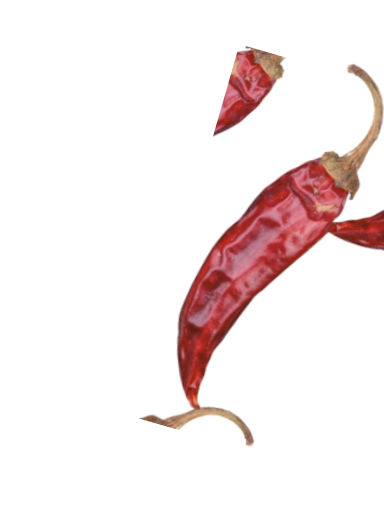
Easily identifiable owing to its long and deeply wrinkled physical attributes, the Byadgi chilli from Karnataka is focused primarily upon its looks and not upon its pungency. It is the most valuable asset of the industry for its coloring properties.
Technical Metrics: Scoville Heat Units: 15,000 – 25,000 (Mild) | ASTM: 150 – 200 (Extremely High Color).
Primary Applications: Byadgi is the best chilli for the extraction of natural oleoresin, cosmetics, and premium quality meats. It enables manufacturers to give their products a rich, mouth-watering red color without compromising the consumer's taste with strong pungency.
Famous for its vibrant "lava red" color and very distinct, yet slightly smoky flavor profile with a strong fruitiness, genuine Kashmiri chillies are a rare, high-end product for use in elite culinary scenarios.
Technical Metrics: 1,000 – 2,000 SHU (Very Mild) | 100 – 140 ASTA (High Color).
Primary Applications: This variety of chilli pepper is highly preferred within gourmet restaurant distribution chains as well as elite Western spice merchants. It offers a striking, fiery red appearance that is typical of traditional South Asian cuisine with virtually no actual heat. Agrocrops Spices Pvt Ltd ensures 100% geographic authenticity to safeguard our customers from artificially colored fake products.
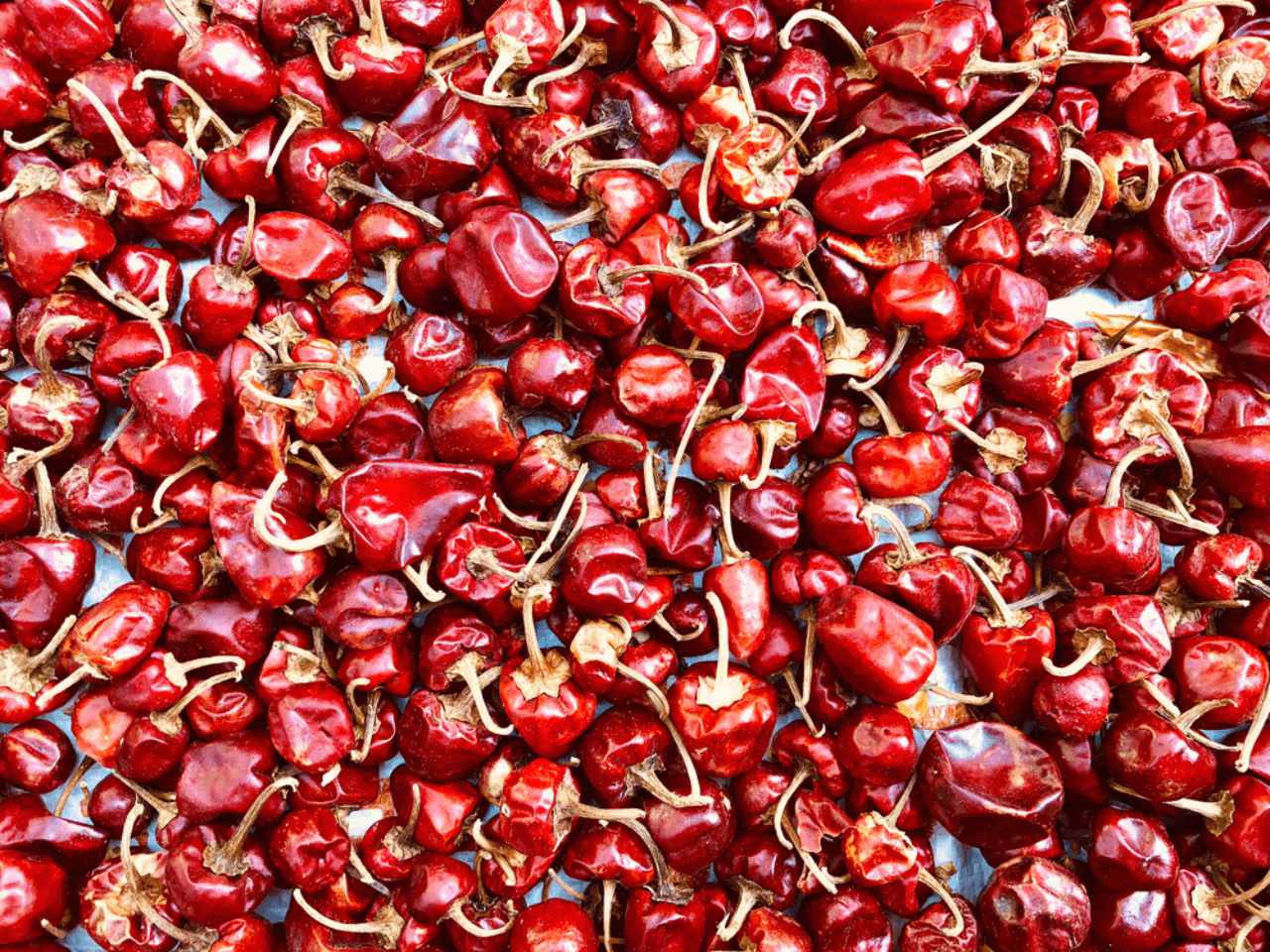
Diverging from the traditional long pepper shape, Mundu is a small, round, cherry-like chilli pepper native to the arid coastal districts of Tamil Nadu. The terroir contributes to a tangy, highly aromatic taste profile.
Technical Metrics: 15,000 – 35,000 SHU (Mild to Medium) | 30 – 50 ASTA (Low-Medium Color).
Primary Applications: Mundu is highly prized for use in high-end South Asian specialty foods, commercial chutney blends, and traditional regional spice blends. Its thick skin enables exceptional warehouse shelf life, and its unusual shape makes it highly desirable for premium retail packaging.
With the progress of modern agricultural science, Sanjivani (Endo 5) has established itself as an emerging brand in the export market. It was bred to fill the space between Sannam and Teja varieties. It is an optimal compromise for large-scale commercial production.
Technical Metrics: 40,000 – 60,000 SHU (Medium-Hot) | 60 – 80 ASTA (Medium-High Color).
Primary Applications: Sanjivani has a slightly higher chroma than Sannam but with an even crisper profile. Large-scale producers prefer it for generic chili powder blends or seasoning mixes. It provides excellent quality at an affordable price point without the luxury price of Byadgi.
The choice of the right variety of chilli is the first step in the procurement process. At Agrocrops Spices Pvt Ltd, we are able to deliver your order in a variety of physical forms that will best suit your manufacturing plans:
The choice of the right variety of chilli is the first step in the procurement process. At Agrocrops Spices Pvt Ltd, we are able to deliver your order in a variety of physical forms that will best suit your manufacturing plans:
Whole Chillies with Stem: The traditional form. The stem is left on the chilli pepper as a natural biological package that seals the volatile oils inside the chilli pepper for the best possible shelf life of 18 months under proper warehousing conditions. This form is best suited for commodity traders or buyers who have invested in high-capacity milling facilities.
Stemless Chillies: The most cost-effective option for modern-day manufacturers. By using our facilities to stem out the chillies from the order before export, the buyer stands to save on freight costs and avoid the costly and labor-intensive exercise of stemming the chillies themselves.
Milled Formats (Crushed Flakes & Powders): Ready for immediate integration into production lines or retail packaging. Do you need precise 5mm pizza flakes or a finer powder with a 60-mesh finish? We mill to exact specifications in pristine conditions. We utilize advanced steam sterilization protocols to guarantee a zero microbial load for absolute food safety compliance.
The Agrocrops Promise: Mitigating Risk and Elevating Export Quality We understand the operational risks you manage each day as a global procurement manager. Fluctuating moisture content can result in catastrophic mold growth during international transit. Physical contaminants can result in failed factory audits. Non-compliance can result in costly customs rejection. Agrocrops Spices Pvt Ltd was created to systematically eliminate these risks from your global supply chain. We're deeply integrated from the farm level to the final closed shipping container. We utilize rigorous quality control protocols at each operational phase:
Advanced Optical Sorting Technology: For absolute purity, we employ the latest optical Sortex equipment. Advanced high-speed cameras with multiple spectrum sensors scan each and every pod, rejecting discolored chillies, stems, stones, and other foreign particles, thus assuring a product of impeccable cleanliness.
Stringent Moisture Content: Excess moisture content is the biggest enemy of a dry spice shipment. We dry our chillies under strict scientific conditions, achieving a moisture content of less than 12%. This ensures complete elimination of the danger of aflatoxin formation, thus assuring absolute freshness of our product irrespective of the duration of the shipment.
Customized Export Packaging: We design a specialized packaging structure that suits your climatic needs. Whether you need to pack your high-ASTA varieties in vacuum-sealed bags to avoid oxidation or need export-grade double poly-lined PP bags for humid climates, we design a specialized structure to ensure your investment is safe.
Unwavering Compliance and Transparency: We provide detailed batch-wise Certificates of Analysis (COA) for all our exports, specifying SHU, ASTA, and moisture content. We ensure that all necessary phytosanitary, microbial, and food safety certifications are taken care of to ensure smooth clearance at customs.
Secure Your Global Supply Chain with Agrocrops Spices Pvt Ltd To procure the right type of chilli from India, it is important to have a scientific understanding of your final product. However, to establish a robust global supply chain, you need a reliable export partner with a history of compliance with international standards, quality standards, and transparent operations.
We at Agrocrops Spices Pvt Ltd take immense pride in being your gateway to the best spice farms in India and the world's leading FMCG manufacturers. If you need a regular supply of premium quality Indian chilli peppers that match your industrial needs, get in touch with our procurement experts.
Get in touch with Agrocrops Spices Pvt Ltd today to know more about your formulation needs, procure lab-tested samples for your R&D team, and take the first step towards an enhanced global spice supply chain.
When you are sourcing spices globally, visual checks just aren't enough. We rely on two main scientific standards to ensure consistency.
SHU (Scoville Heat Units) tells us exactly how potent a pepper is based on its capsaicinoid levels.
On the other hand, the ASTA Color Value measures the amount of red pigment in the spice.
Basically, if you need intense heat for a hot sauce, you look for a high SHU rating. But if you are looking for a natural red dye for cosmetics or food without adding heat, a high ASTA and low SHU combination is your best bet.
If your product requires serious heat, Teja (S17) is our benchmark.
Grown in the nutrient-dense soils of Telangana and Andhra Pradesh, it packs a massive punch, registering between 75,000 and 110,000 SHU.
It is the go-to raw material if you are extracting industrial-grade capsaicin or crafting extreme hot sauces.
Because the heat is so intense, you actually need less raw material to hit your target pungency, which makes it an incredibly cost-effective choice for large-scale production.
For a rich, natural color without a fiery kick, the Byadgi chilli is a fantastic choice.
It offers an extremely high color value (150 to 200 ASTA) with only a mild heat profile (15,000 to 25,000 SHU).
This makes it perfect for cosmetics, premium meats, and natural oleoresin extraction where appearance is key.
Another great option is the genuine Kashmiri chilli. It provides a vibrant "lava red" appearance and a slightly smoky flavor, but is very mild, sitting at just 1,000 to 2,000 SHU.
Food safety regulations are getting stricter every year, especially in regions like the European Union, the UK, and Japan.
These areas strictly enforce Maximum Residue Limits (MRL) for agricultural imports.
IPM chillies are grown using highly monitored agricultural practices to keep their chemical footprint incredibly low.
Buyers are rapidly shifting toward IPM crops because it simply isn't worth the risk of having a multi-million dollar shipment rejected at the destination port over pesticide residues.

Copyright in the pages and in the screens displaying the pages, and in the information and material therein and in their arrangement, is owned by Agrocrops Singapore Pte. Ltd. unless otherwise indicated.
The information and materials contained in these pages - and the terms, conditions, and descriptions that appear - are subject to change.
Agrocrops Singapore Pte. Ltd. and its group of companies, contractors, buyers and suppliers are the owners of the trade and service marks appearing on this website and all rights are reserved in respect of such trade and service marks.
The information and materials contained on this site, including text, graphics, links or other items - are provided “as is,” “as available. Agrocrops Singapore Pte. Ltd. does not warrant the accuracy, adequacy or completeness of the information and materials and expressly disclaims liability for errors or omissions therein. No warranties of any kind, implied, express or statutory, including but not limited to the warranties of non-infringement of third party rights, title, merchantability, fitness for a particular purpose and freedom from computer virus, are given in conjunction with the information and materials.
Agrocrops Singapore Pte. Ltd. shall in any way be liable for any damages, including without limitation direct or indirect, incidental, or consequential damages, losses or expenses arising in connection with this site or use thereof or inability to use by any party, or reliance on the contents of this site, or in connection with any failure of performance, error, omission, interruption, defect, delay or failure in operation or transmission, computer virus or line or system failure, even if Agrocrops Singapore Pte. Ltd., its representatives, are advised of the possibility of such damages, losses or expense.
All information, ideas, know-how and feedback provided and submitted to Agrocrops Singapore Pte. Ltd. through this site shall be deemed and remain the property of Agrocrops Singapore Pte. Ltd. for any and all purposes.
By accessing this, you agree to Singapore law shall govern such access and you agree to submit to the exclusive jurisdiction of the Singapore courts.
Please read the following Website Terms and Conditions carefully before using the Site and/or the Services, so that you are aware of your legal rights and obligations with respect to Agrocrops Singapore Pte. Ltd. and/or its related entities, affiliates and subsidiaries, and their respective successors-in-title (individually and collectively, “Agrocrops Singapore Pte. Ltd.”). If you do not agree to these Terms of Use, please do not use our Services.
These terms of service (“Terms”) govern your use and access to our services, including our website (our “Site”), our application (s) (our “App”), our application programming interfaces, our email notifications, and any information or content appearing therein, collectively our services (“Services”), regardless of whether you are a paid user or a non-paying visitor. All of the services available on or through the Site or otherwise offered, maintained and/or provided by us are referred to in this document as our "Services".
The Services and the Site are operated and provided by Agrocrops Singapore Pte. Ltd. (“Agrocrops”, "We" or “Us”) on behalf of itself and its group companies. Agrocrops is registered in Singapore under company number UEN : 202120863N and have our registered office at #3 Shenton Way, Shenton House #15-02, Singapore 068805 which is also our head quarters.
If you reside in Singapore or anywhere else in the world, your agreement is with Agrocrops Singapore Pte. Ltd.
The site and its contents are owned and operated by Agrocrops, and as such is Copyrighted. All company names and logos and all related products and service names, design marks and slogans are trademarks and service marks and are the properties of their respective owners and may not be reproduced or appropriated in any manner without the written permission of their respective owners. References to any names, marks, products or services of third parties do not necessarily constitute or imply Agrocrops’ endorsement, sponsorship or recommendation of the third party, information, product or service. No material, graphic or image from the Products may be appropriated or modified in any manner, or reproduced, republished, uploaded, posted, transmitted or distributed in any way, without the prior written permission of Agrocrops.No party is permitted to establish links to the Products without prior written permission from Agrocrops. Agrocrops reserves all right to deny permission for any such links. Agrocrops is not under any obligation to establish reciprocal links with any third party. Nothing contained herein confers any license or right under any copyright, patent, trademark or other proprietary rights of Agrocrops or any third party.
Agrocrops respects intellectual property rights of others and ask that you do too. In the event of suspected copyright infringement, please email us at samsu@agrocrops.com. We will respond to notices of alleged copyright infringement that comply with applicable legal requirements and properly provided to us.
Neither Agrocrops, any of its affiliates, subsidiaries, employees, agents, partners, principals and representatives nor any other person is, in connection with this site, engaged in rendering auditing, accounting, tax, legal, advisory, consulting or other professional services or advice. Each user agrees not to use the content of the Products as a substitute for independent investigations and competent financial and business judgment of the user of the Products and such user shall obtain professional advice tailored to his particular factual situation. Each user is responsible for all matters arising from its use of the Products.
Each user agrees to use the Products or services in accordance with these terms of use and for lawful and proper purposes and shall not:
The products and services may contain hyperlinks to other websites ("External Sites") which are neither maintained nor controlled by Agrocrops, or may contain content posted on or via the Products by third parties. Agrocrops shall not be responsible for any errors or omissions in any content in the products, services, or the content, products or services of any hyperlinked External Site or any hyperlink contained in a hyperlinked External Site, nor for the privacy and security practices employed by these External Sites, and under no circumstances shall Agrocrops be liable for any loss or damage of any kind incurred as a result of the use of any content posted or contained in e-mails or otherwise transmitted or displayed via the Products, or arising from access to External Sites. Use of the Products and any hyperlinks and access to External Sites are entirely at the user’s own risk.
The user acknowledges that Agrocrops has no control over and excludes all liability for any material on the Internet which can be accessed by using the Products. Neither will Agrocrops be deemed to have endorsed any such content thereto.
Agrocrops takes certain industry-accepted precautions to secure the products, services or portions thereof. However, the user understands and agrees that such precautions cannot guarantee that use of the products or services is invulnerable to security breaches, nor does Agrocrops make any warranty, guarantee, or representation that use of the products or services are protected from all viruses, worms, Trojan horses, and other vulnerabilities.
During the user’s use of the products or services, Agrocrops may issue to and request from the user’s computer "cookies" to enable more convenient browsing when the user revisits the site. The user must not alter any cookies sent to his/her computer from the site and must ensure that the user’s computer sends correct and accurate cookies in response to any relevant request from the site.
Agrocrops is committed to protecting and respecting your personal data.
Please read the Privacy Policy to understand our views and practices regarding your personal data and how we will treat it.
While every effort has been made to ensure that the information provided in this website herein is up to date and accurate, Agrocrops and its affiliates, subsidiaries, employees, agents, partners, principals and representatives make no representation or warranty of any kind either express or implied as to the completeness, correctness, accuracy, suitability, reliability or otherwise of the website or its content in this website or the results of its use for any purpose, all of which is provided "as is" and "as available". They do not warrant that this website or this server that makes it available is free of any virus or other harmful elements. Agrocrops and its affiliates, subsidiaries, employees, agents, partners, principals and representatives disclaim all warranties and obligations relating to this website, including but not limited to all implied warranties and obligations of merchantability, fitness for a particular purpose, title and non-infringement.
The information contained herein in this website shall be accessed and used at the user's own risk and to the fullest extent permissible and subject and pursuant to all applicable laws and regulations. Agrocrops and its affiliates, subsidiaries, employees, agents, partners, principals and representatives shall not be liable for any direct, indirect, incidental, special, exemplary, consequential or other damages whatsoever, (including but not limited to liability for loss of use, data or profits), including but not limited to contract, negligence or other tortious actions, arising out of or in connection with this site, even if any of Agrocrops and its affiliates, subsidiaries, employees, agents, partners, principals and representatives has been advised of the possibility of such damages or losses that were, are being or will be incurred.
Agrocrops reserves all rights to make any and all changes in this website at its sole discretion without prior notice to the user. Agrocrops reserves the right to deny access to this website to anyone at any time without prior notice. Materials on our website may include technical inaccuracies or typographical errors. Changes may be periodically incorporated into this material. Agrocrops may make improvements and/or changes in the products, services and/or programmes described in these materials at any time without notice.
Should the user respond to any part of the materials contained herein in this website with any communications including feedback data, such as questions, comments, suggestions, or the like, such information shall be deemed to be non-confidential and Agrocrops and its affiliates, subsidiaries, employees, agents, partners, principals and representatives shall have no obligation whatsoever with respect to such communications and shall be free to reproduce, use disclose and distribute the information to others without limitation, and shall be free to use in any way for any purpose whatsoever the content of such communications including any ideas, know-how, techniques or concepts disclosed therein.
The law applicable to the terms of use of this website is the law of the Republic of Singapore and the courts of the Republic of Singapore will have exclusive jurisdiction in case of any dispute.
We are committed to protecting and respecting your privacy. We collect your personal information and process your personal data in accordance to the law which regulates the processing of personal data. Please read the following carefully to understand our views and practices regarding your personal data.
This online privacy statement describes Agrocrops current online practices in respect of personal information collected through this website. If you do not agree with these terms, please do not disclose any personal information to us.
We collect your personal information in order to provide and continually improve our quality, approach, process and services that help you interact with the peanut community and us in a better way.
All our subsidiaries, associate companies, partner firms and any third party working with or for us, and who have access to personal information, will be expected to read and comply with this policy. No third party may access or process sensitive personal information held by us without having first entered into a confidentiality agreement.
Agrocrops privacy policy is subject to change for improvement at any time without any notification. To make sure you are aware of any changes to the policy, you may review the policy periodically.
This privacy policy was last amended on 18th of September 2020.
We collect personal data that is relevant to our business and/or employment relationship with you.
If you are a shareholder, director, corporate officer, manager, employee or appointed contractor of any business entity or individual, we may collect your personal data if it is relevant to our business relationship with you or in that entity.
We may collect personal data directly from you. We may sometimes collect information about you through third party when they are duly authorized by you to provide personal data from you. This may be done in person when you meet our staff or representatives, or over the phone, by email or through websites.
We may also collect your personal data about you from third party sources without directly involving you. For example, we may obtain your personal data from your family members or a government agency. We may also obtain your personal data from market research organizations or publicly available resources such as telephone directories or business directories.
A cookie is a text-only string of information that is transferred to the cookie file of the browser on your computer's hard disk so that we can recognize you as a repeat visitor.
A cookie will typically contain the name of the domain from which the cookie has come, the "lifetime" of the cookie, and a value, usually a randomly generated, unique number. Cookies are commonly used by most major websites to arrange their content to match your preferred interests.
This website will automatically gather personal information, such as your first name and email address, through the use of cookies when accessing enhanced and premium areas of the website.
Two types of cookies are used on this website:
These are temporary cookies that remain in the cookie file of your browser until you leave the site. We use session cookies:
These remain in the cookie file of your browser for much longer. We use persistent cookies:
The key purpose for which we need your personal data is to process your application or request, to proceed with any employment offers or business relationship with you or to contact you to provide any information to you pertaining to the Agrocrops. These include:
We do not provide your personal data to third parties outside the Agrocrops for purposes other than those set out above or purposed related to those set out above. We do not sell your personal data to any third parties.
We may disclose and/or share your information under the following circumstances:
Your personal information may be stored and processed in any country where we have offices or servers or in which we engage service providers. Your personal information may be transferred to countries outside your country of residence, which may have different data protection and data processing laws than those in your country. Any such transfer shall take place only in accordance with and as permitted by the law of your jurisdiction, but please be aware that the laws and practices relating to the protection of personal information are likely to be different, and in some cases may be weaker than those within your home jurisdiction. Regardless, in all events, we shall apply the provisions of this Privacy Policy to your personal information wherever it is located.
We have implemented technical, physical, and organizational security measures to protect against the loss, misuse, and/or alteration of your information. These safeguards vary based on the sensitivity of the information that we collect and store. However, we cannot and do not guarantee that these measures will prevent every unauthorized attempt to access, use, or disclose your information since despite our efforts, no Internet and/or other electronic transmissions can be completely secure.
Agrocrops does not knowingly collect personal information or any other identifying data from children under 13 years of age. If we become aware that we have collected personal information (as defined by the Children’s Online Privacy Protection Act) from children under the age of 13, or personal data (as defined by the EU GDPR) from children under the age of 16, we will take reasonable steps to delete it as soon as practicable.
We retain the information we collect for as long as necessary to fulfil the purposes set forth in this Privacy Policy or as long as we are legally required or permitted to do so. Information may persist in copies made for backup and business continuity purposes for additional time.
Agrocrops website may contain links to third-party websites, third-party plug-ins. If you choose to use these sites or features, you may disclose your information not just to those third-parties, but also to their users and the public more generally depending on how their services function. Agrocrops is not responsible for the content or privacy practices of such third party websites or services. The collection, use and disclosure of your information will be subject to the privacy policies of the third party websites or services, and not this Privacy Policy. We encourage you to read the privacy statements of each and every site you visit.
We will continue to evaluate this Privacy Policy as we update and expand our business and services, and we may make changes to the Privacy Policy accordingly. We will post any changes here and revise the date last updated above. We encourage you to check this page periodically for updates to stay informed on how we collect, use and share your information. If we make material changes to this Privacy Policy, we will provide you with notice as required by law.
If you have any questions about this Privacy Policy or our privacy practices, you can contact us at: samsu@agrocrops.com