
India has been one of the world's largest suppliers of dry red chillies for many years, serving food manufacturers, spice companies, wholesalers, and importers across global markets. Its wide range of chilli varieties and strong export infrastructure continue to support growing international demand. The country ensures a consistent supply throughout the year because of its large farming base and modern processing infrastructure.
According to official trade figures published by the Agricultural and Processed Food Products Export Development Authority (APEDA), India exported approximately 717,000 tons of dry red chillies in 2025. This consistent performance shows high global demand. Indian chillies are popular due to their brilliant colour, quality and availability, which is why they continue to be a favourite choice in global trade.
Major Dry Red Chilli Varieties Exported from India
One of India’s key competitive advantages is its ability to supply a wide range of chilli varieties. These varieties meet different industrial and commercial requirements.
| Variety | Key characteristics | Major Markets |
|---|---|---|
| Guntur Sannam | High pungency, rich red colour | China, Bangladesh, Thailand |
| Byadgi | High colour value, mild heat | Malaysia, Indonesia, and Singapore |
| Teja | Very high pungency, high capsaicin content | China, the USA, and other Asian markets |
| 334 Chilli | Balanced colour and heat | USA, UK, UAE, EU countries |
| Wonder Hot | Strong pungency and processing suitability | China, Vietnam, Sri Lanka, and the Middle East countries |
These varieties allow buyers to choose based on colour value, pungency level, moisture specifications, and end-use applications.
India's Dry Red Chilli Export Volume Shows Positive Momentum
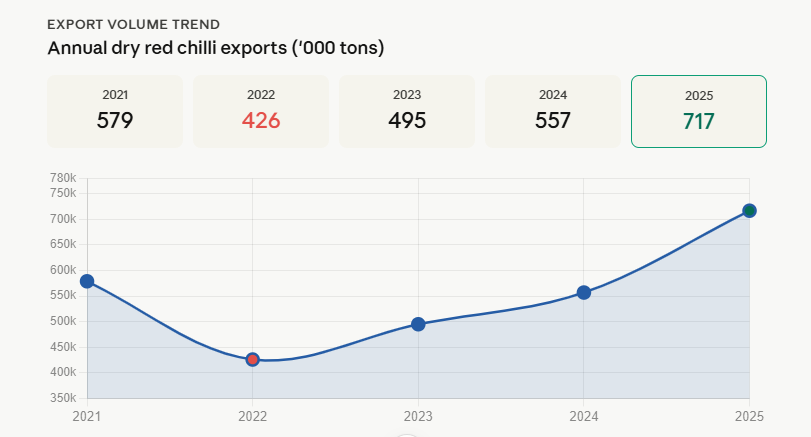
According to APEDA export statistics and India's international trade data, the dry red chilli export sector has demonstrated strong performance over the past few years despite fluctuations in global trade conditions.
| India Dry Red Chilli Exports | |
|---|---|
| Years | Volume ('000' tons) |
| 2021 | 579 |
| 2022 | 426 |
| 2023 | 495 |
| 2024 | 557 |
| 2025 | 717 |
Source: APEDA Export Statistics, Directorate General of Commercial Intelligence & Statistics (DGCIS), and India’s International Trade Data (2021–2025).
Exports decreased in 2022 due to global market disruptions and supply chain changes. The market started to recover as demand for chillies increased. By 2023, export volumes had returned to previous levels, showing a sustained recovery. According to APEDA export data, exports rose from 495,000 tons in 2023 to around 717,000 tons in 2025. The increase also reflects stronger demand from food processing industries and growing consumption of spice-based products in major importing countries.
The sharp rise in exports highlights increasing demand from international food processors, spice manufacturers, and packaged food producers
Key Markets Driving India's Dry Red Chilli Exports
India has been one of the major exporters of dry red chillies to several countries. Asian markets account for a major share of total shipments. According to India’s export trade statistics for 2025, the following countries accounted for the largest share of Indian dry red chilli exports.
| Export Market | |
|---|---|
| Countries | Share |
| China | 46.00% |
| Thailand | 9.00% |
| Bangladesh | 8.00% |
| Sri Lanka | 6.00% |
| USA | 6.00% |
| Indonesia | 5.00% |
| Malaysia | 3.00% |
| Others | 17.00% |
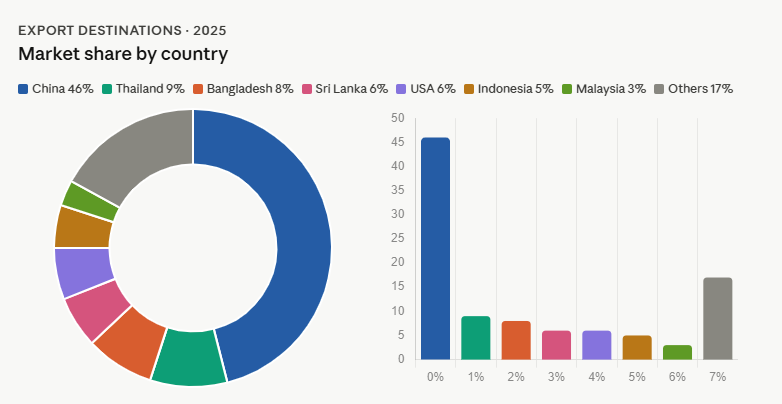
Source: APEDA Export Statistics and India's International Trade Data, 2025.
China remained the dominant buyer of Indian dry red chillies in 2025. The country's large-scale food processing industry continues to create substantial demand for chilli products used in sauces, seasonings, spice blends, and packaged foods.
Bangladesh accounted for approximately 8% of India's dry red chilli exports in 2025. The country relies heavily on Indian chillies for domestic consumption and food processing applications.
The United States is another important market for Indian chilli exports. Volumes of imports have remained stable, buoyed by stronger demand for ethnic cuisines, natural spices, and ingredients for processed food. The growing food processing industries in Sri Lanka, Indonesia, and Malaysia continue to be steady buyers of chillies.
Why Global Buyers Choose Indian Dry Red Chillies
Many international buyers also prefer Indian suppliers because they can source multiple chilli grades from a single origin. This simplifies procurement, helps maintain product consistency, and reduces sourcing complexity for food manufacturers and spice processors.
Indian dry red chillies have established a good reputation in the international market on account of their quality, variety, and consistent supply. One of the major advantages India has is the availability of several varieties of chillies catering to different market requirements. Products can be sourced by colour value, pungency levels, moisture specifications, and processing applications.
The country’s extensive cultivation base provides for steady production volumes and helps exporters to fulfill large-scale contracts throughout the year. This reliability is essential for food manufacturers and spice processors who rely on a consistent supply of raw materials.
India's competitive pricing further strengthens its position in the global chilli trade. The well-established logistics networks and export knowledge of Indian suppliers continue to meet the sourcing needs of buyers from many international markets.
Expanding Opportunities for Importers and Food Manufacturers
Consumer preferences are changing across many markets, with greater demand for natural ingredients, ethnic cuisines, and flavour-rich food products. This trend continues to support the global spice industry and creates new opportunities for chilli exporters. Dry red chillies remain a key ingredient in seasoning mixes, ready-to-eat meals, sauces, snack products, and processed foods. Demand for high-quality chilli products is expected to grow further as food manufacturing industries expand across Asia, North America, and emerging markets.
Importers will continue to source suppliers capable of assuring quality consistency, traceability, food safety, and on-time deliveries. India is also well placed to meet the demand on account of its strong agricultural base, modern processing, and export-oriented supply chain.
Outlook for India's Dry Red Chilli Export Industry
The rise in exports in 2025 is a positive signal for India’s dry red chilli segment. Recent APEDA export data shows steady growth in India's dry red chilli exports, further strengthening India’s position as a leading global supplier. This growth is supported by strong demand from key markets such as China, Bangladesh, Thailand, and the United States.
Looking ahead, India's dry red chilli industry remains well-positioned for continued growth. Strong agricultural production, established export networks, and long-standing relationships with international buyers are expected to support export demand in the coming years.
Overall, the chilli export market in India continues to open up good opportunities for importers who are looking for reliable suppliers they can work with over the long term.
Quality Factors Importers Should Evaluate
When sourcing dry red chillies, international buyers often evaluate colour value, pungency level, moisture content, cleanliness, packaging standards, and compliance with destination-country food safety requirements. These factors play an important role in ensuring product consistency and successful import operations
Looking for a Trusted Indian Dry Red Chilli Supplier?
Contact our export team for product specifications, quality parameters, packaging options, and competitive export pricing tailored to your market requirements. We serve importers, wholesalers, food processors, spice manufacturers, and distributors worldwide with export-grade dry red chillies backed by strict quality control and reliable global shipping.
FAQs
-
Why is India one of the largest exporters of dry red chillies?
India benefits from favourable growing conditions, high agricultural output, diverse chilli varieties, and a well-established export network that meets international demand for quality and quantity.
-
Which country is the largest importer of dry red chillies from India?
China is the largest importer of India's dry red chillies, taking approximately 46% share in total exports. China's large food processing, seasoning, and packaged food industries continue to drive strong demand for Indian dry red chillies.
-
Why are Indian dry red chillies in demand in international markets?
Indian dry red chillies are known for their deep colour, high pungency, consistent quality, and wide variety of available grades. Indian red dry chillies are widely used in flavour compositions, sauces, processed foods, seasoning, and food processing.
-
Who are the major buyers of Indian dry red chillies apart from China?
Other major export destinations include Bangladesh, Thailand, the United States, Sri Lanka, Indonesia, and Malaysia, in addition to China. These countries import Indian chillies for the processing of food items, for the production of spices, and for domestic consumption.
-
What was India’s dry red chilli export in 2025?
India's export volume of dry red chillies was around 717 thousand tons in 2025. This clearly indicates a consistent high demand for Indian chillies from the world over.
-
What are the industries using imported dry red chillies?
Dry red chillies are used in spice companies, food factories, sauce makers, snack producers, restaurants, and ready-to-eat food brands.
-
Can buyers get different types of Indian chillies?
Yes. India has various types of dry red chillies in terms of colours, size, and intensity of heat. Buyers can have a look at each variety to select a specific kind suitable for their respective trade.
-
Why do food industries prefer to source their dried red chillies from India?
Food industries source dry red chillies from India because of reliable supply, competitive pricing, consistent quality standards, export expertise, and the ability to fulfill large-volume orders according to buyer specifications.
-
Would demand for Indian dried red chillies increase in the future?
Yes. Growing demand from processed food manufacturers, spice companies, sauce producers, and ethnic food brands is expected to support long-term demand for Indian dry red chillies in international markets.
-
What benefits do Indian chilli exporters offer to importers?
Indian chilli exporters provide consistent quality, competitive pricing, export documentation support, reliable logistics, and compliance with international food safety requirements. These advantages help importers maintain stable supply chains and reduce sourcing risks.
