

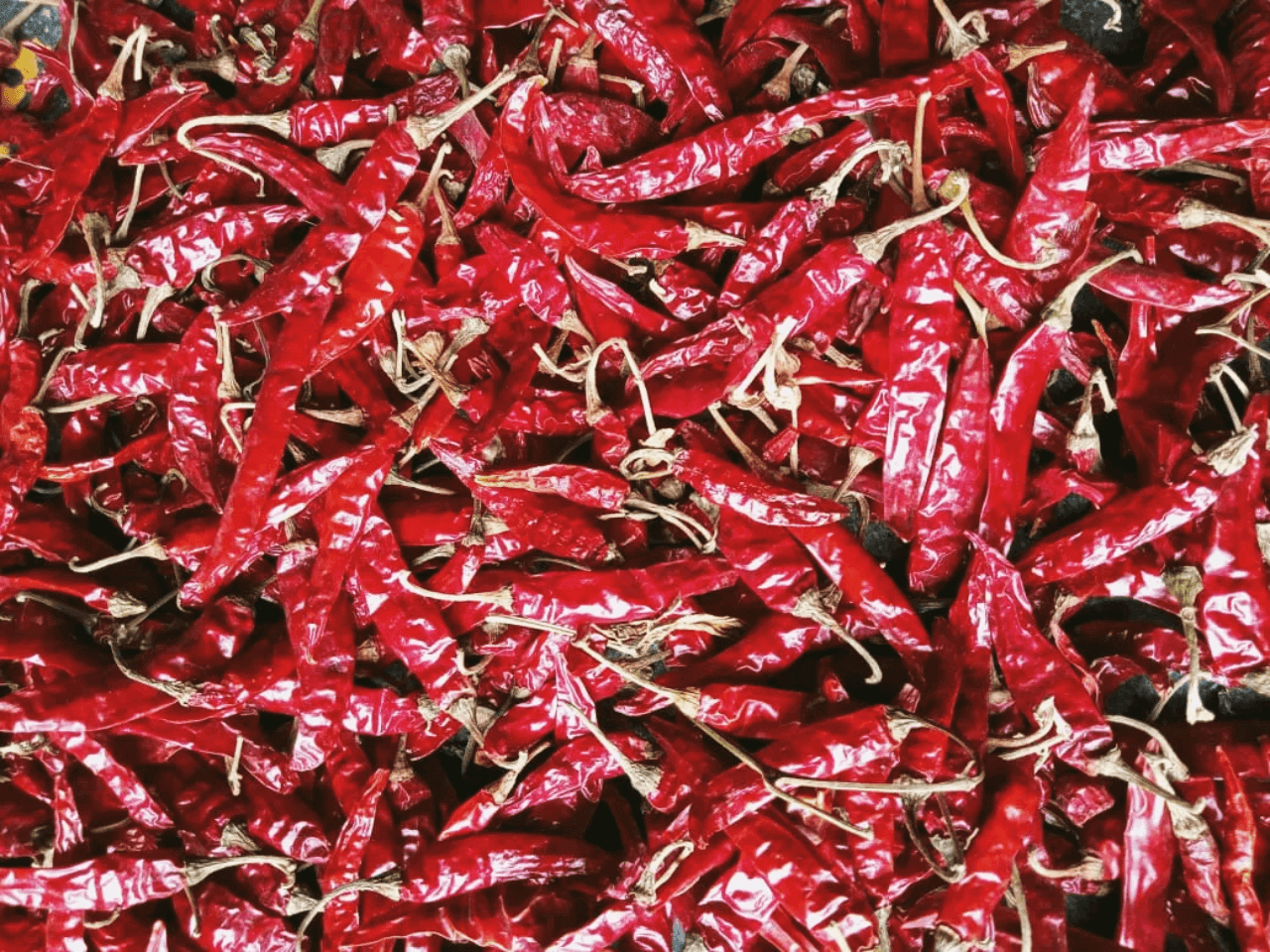
India is very good at making red chillies and exporting them. Every year India exports millions of tonnes of red chillies to people who make food, process spices sell things to stores and import goods all over the world. Indian dry red chillies are used in a lot of things like spice mixes, sauces to eat foods and snacks because they are colourful and taste good. They also come in levels of heat, which is why people like them so much.
If you’ve sourced dry red chillies from India, you’ve likely come across terms like 000 Grade, 00 Grade, S4 Grade, S5 Grade, Deluxe Grade or FAQ Grade. Such grading terms can be confusing to many buyers, especially those who are new to the spice trade. They are not varieties of chilli. They are commercial grades of quality to enable buyers and sellers to better communicate about the quality of the product.
Understanding these grades is more than just knowing the industry lingo. The grade you choose can impact your production efficiency, product consistency, processing costs and even customer satisfaction. If you are buying whole chillies for retail packing or for raw material for chilli powder production, choosing the right grade ensures that you are getting a product that suits your business needs.
What Are Dry Red Chilli Export Grades?
Export grades for dry red chilli are trade terms used to describe the physical quality of a consignment of chillies. These grades are not used to identify the variety of the chilli but to specify how well the chillies meet certain quality parameters, e.g. appearance, cleanliness, colour, uniformity etc.
It’s important to note that there is no government standard for commercial grades. Specifications may vary slightly between exporters and destination markets, so it is always important to confirm the exact quality parameters before placing an order.
Why Chilli Grading Matters in International Trade?
Consistency of quality is one of the biggest priorities in the global spice industry. Buyers don’t just buy chillies: they buy reliability.
A chilli powder manufacturer in the food sector expects each batch to yield the same colour, pungency and processing performance. Likewise, wholesalers and retailers want attractive products on store shelves, and exporters need to ensure that each shipment meets buyer specifications.
Grading also allows for transparency for exporters. Buyers compare products on measurable quality attributes rather than only negotiating on price, leading to more informed and efficient procurement decisions.
How Indian Exporters Grade Dry Red Chillies
Chillies are subjected to several quality checks before packing for export. Exporters consider several physical attributes to determine the appropriate commercial grade.
Consistency and size of pods:
Buyers are among the first to notice the size of chilli pods. Premium grades typically have pods that are similar in length and appearance, which makes the shipment appear cleaner and more consistent.
Uniformity helps in processing too, especially in automated production lines.
Color:
Bright, vibrant red chillies are generally more desirable in domestic and international markets. The rich natural colour not only enhances the visual appeal but also plays an important role in products such as chilli powder, spice blends, sauces and seasonings.
Commercial grades are usually lower for batches of uneven or faded colours.
Stem Condition:
Chillies can be supplied with stems attached, partially stemless or stemless depending on the buyer's requirements.
Removing stems requires additional labour and processing, which is why stemless grades often command a higher price.
Moisture Content:
Maintaining proper moisture levels is essential to preserving product quality during storage and transportation.Excess moisture can lead to mould growth, colour changes, fungal contamination and/or reduced shelf life. So, the export quality chillies are processed and stored with care to maintain the moisture levels as per the customer’s specifications.
Foreign Matter:
All export shipments are cleaned to remove undesirable materials such as dust, stones, stems, plant debris and other impurities.
Exporters are equipped with modern cleaning and sorting equipment to deliver products with strict international quality standards.
Understanding Common Indian Export Grades
While there may be slight variations among exporters in grading standards, several commercial grades are widely recognised in international chilli trade.
000 Grade:
000 Grade is often considered to be one of the highest-quality commercial export grades available.This grade is selected for its good appearance, high uniformity and low defects. Buyers who are looking for a good looking whole chilli will prefer this grade for its premium presentation.
Buyers can generally expect:
- Bright natural red colour
- Excellent cleaning quality
- Uniform pod size
- Very low foreign matter
- Minimal broken or damaged pods
- Attractive overall appearance
000 Grade is commonly supplied to premium retail brands, international wholesalers, gourmet food companies, and customers who place significant importance on presentation.
00 Grade:
00 Grade offers an excellent balance between quality and affordability, making it one of the most popular choices among international buyers.While it may allow slightly more variation than 000 Grade, it still delivers reliable export quality suitable for a wide range of food applications.
Buyers can generally expect:
- Good colour consistency
- Uniform pod size
- Low levels of foreign matter
- Minimal damaged pods
- Reliable processing performance
This grade is widely used by spice manufacturers, food processors, wholesalers, and ingredient suppliers who require dependable quality without the premium pricing associated with top-grade products.
S4 Grade:
S4 Grade is a practical choice for buyers who prioritise processing efficiency and value.Compared with premium grades, S4 allows slightly greater variation in pod size and appearance while still maintaining acceptable export standards.
Its typical characteristics include:
- Good commercial colour
- Moderate pod uniformity
- Clean processing quality
- Acceptable percentage of broken pods
- Low foreign matter after cleaning
Since appearance is often less critical in industrial processing, S4 Grade is widely used by manufacturers producing chilli powder, spice blends, sauces, seasonings, and oleoresins.
S5 Grade:
S5 Grade is another commonly traded commercial grade, particularly for large-scale industrial processing.It generally allows greater variation in appearance than premium grades while still meeting agreed export specifications.
Typical features include:
- Commercial-quality red colour
- Moderate pod uniformity
- Economical pricing
- Acceptable cleaning standards
- Slightly higher tolerance for broken pods
Because these chillies are often ground, blended, or processed into food ingredients, visual appearance becomes less important than functionality.
Why Select Agrocrops Spices?
Selection of the correct chilli variety isn’t enough by itself – selecting a reliable supplier capable of delivering consistently high-quality product that precisely matches your specifications is just as important.
Agrocrops Spices is a company specializing in procurement and distribution of high-quality Indian dry red chillies to our clients all over the domestic and global market. Working closely with trusted local farmers of these products’ main growing areas ensures consistent high quality of color, strength, purity and freshness of our chillies.
Be it the colorful Byadgi chilli, high-performing Guntur chilli or powerful Teja chilli, we’ll help you select the variety that suits your needs most perfectly.
All of our products undergo processing and packing aimed at preserving their quality properties while fulfilling industry and export norms. That’s why we’re proud to have established ourselves as a reliable supplier of spices to spice producers, food processors, wholesalers, retailers and importers.
Conclusion:
Each grade of dried red chili has certain characteristics. Knowing them will help you make better purchases. The spice industry has many levels of grading. Commercial grading systems like 000, 00, S4, S5, FAQ, Deluxe, and Stemless are helpful when assessing dried red chili based on how it looks, how clean it is, the uniformity, and how fit it is for processing.
These grading systems are not universal and are commercial nomenclature. There is a lot of export diversity in these grading systems. Look at a product's detailed specifications before purchasing.
Partnering with a supplier you trust and choosing the grade fit for your needs will help you make the most of every shipment. It will also help you keep the quality of your production and product the same throughout.
FAQs
-
What is the difference between 000 Grade and 00 Grade chillies?
000 Grade consists of Fresh Whole Export Chilli and represents a higher standard of visual appeal and cleanliness as compared to 00 Grade. 000 Grade is preferred as a premium whole export grade for whole chilli export.
-
Are S4 and S5 Grades suitable for chilli powder?
Yes. S4 and S5 Grade chillies are popular among chilli powder, seasoning and food manufacturers because they have low visual appeal and therefore are suitable for their processing.
-
Do export grades of chillies signify pungency?
No. Export grades speak of the physical quality of chillies and their visual appeal, cleanliness, and uniformity. The pungency of the chilli and its variety is usually assessed in terms of the Scoville Heat Units (SHU).
-
Why do different suppliers have different export grade specifications?
There are no universally accepted standards for grades in spices for the suppliers to comply with. However, the names of commercial grades in the spice trade are widely recognized. Exporters may have slight variations in their grading systems according to their clients, destinations, and their processing methods.
-
How can purchasers get the chilli grade they want?
It is important to get a detailed product specification that states the quality and quantity of moisture, pod size, stem cut, foreign matter, defects, and other quality parameters. It is also important to work with an experienced and consistent exporter.
