


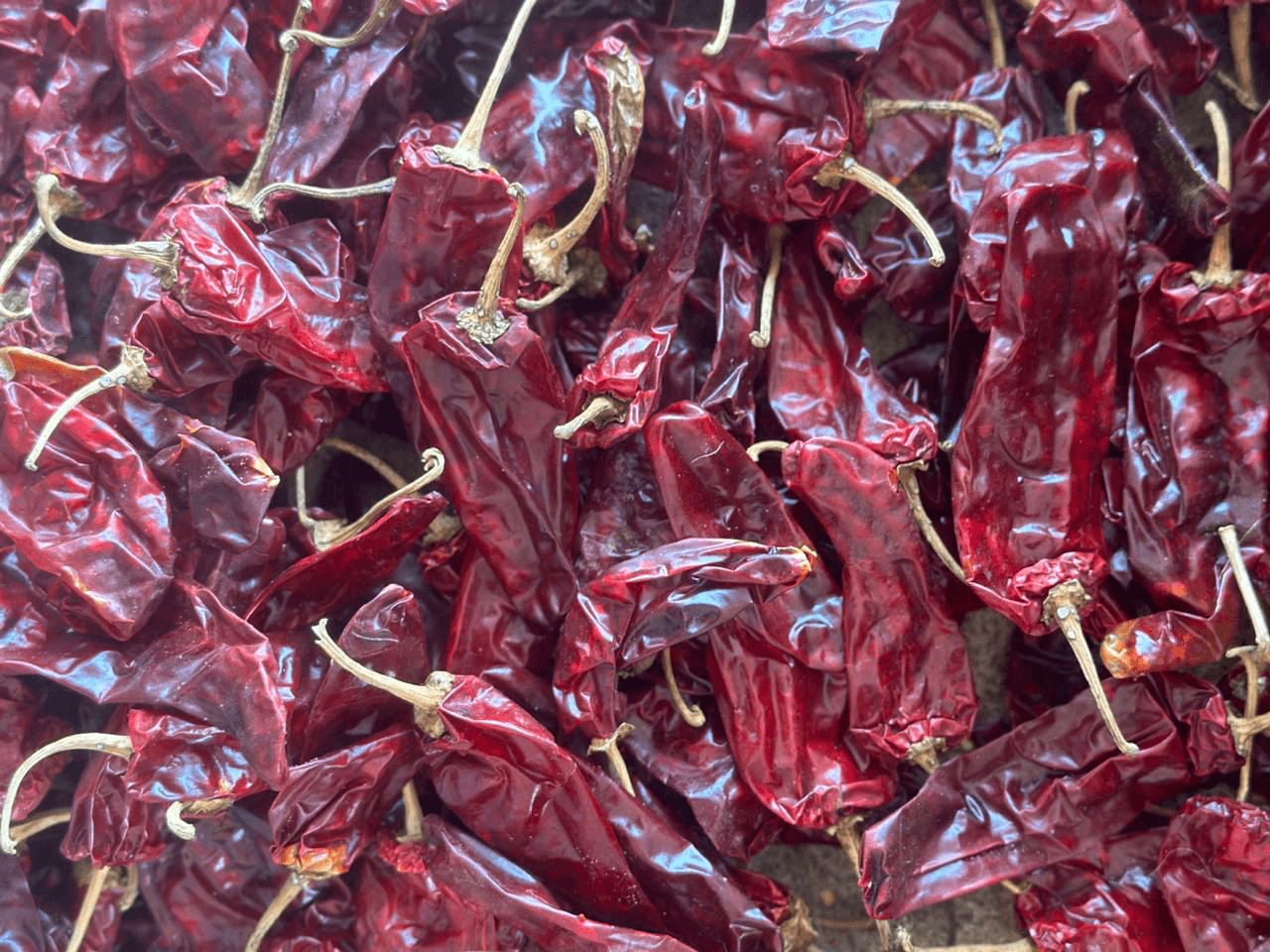
Not every dry red chilli belongs in every product. That sounds obvious, but a lot of buyers still shop by “reddest” or “hottest” and end up with a chilli that’s wrong for the job. The one that makes a killer chilli powder might fall flat in a pickle. The one that’s perfect for a spice blend could be way too mild — or way too aggressive — for a hot sauce.
India grows an enormous range of dry red chilli, and each variety brings its own mix of colour, heat, aroma, and appearance to the table. Getting familiar with these differences before you place a bulk order saves a lot of headaches later. Below are some of the varieties that come up most often in food processing, and where each one tends to fit.
BYADGI — THE COLOUR CHILLI
If you’ve ever wondered how a seasoning or masala gets that deep, almost brick-red look without setting your mouth on fire, there’s a decent chance Byadgi’s involved. Grown mainly in Karnataka, it’s prized for exactly that combination: strong red colour, moderate heat.
It turns up in chilli powder, spice blends, pickles, sauces, masala products, snack seasonings, and oleoresin extraction. Basically, anywhere a manufacturer wants a rich red appearance without cranking up the spice level, Byadgi tends to be on the shortlist.
TEJA — WHEN YOU ACTUALLY WANT THE HEAT
Teja is the opposite story. It’s one of India’s most widely traded chillies specifically because it delivers strong, noticeable pungency, and manufacturers reach for it when a product genuinely needs to be spicy — think chilli powder blends, hot sauces, spice mixes, and other properly fiery items.
One thing worth flagging, though: heat isn’t fixed just because the bag says “Teja.” Growing conditions, how ripe the pods were at harvest, drying method, even storage — all of it nudges the pungency up or down between lots. So don’t just order Teja and assume consistency. Specify the heat level you need and actually verify the shipment against it.
GUNTUR SANNAM — THE ONE THAT DOES A BIT OF EVERYTHING
Coming out of Andhra Pradesh, Guntur Sannam is a workhorse in the Indian spice trade, and for good reason — it strikes a fairly balanced note between colour and heat that suits a long list of products: chilli powder, curry powders, masala blends, pickles, sauces, seasonings, and ready-to-eat foods.
If your company runs several product lines and doesn’t want to juggle five different chilli varieties, Guntur Sannam is often the practical middle ground.
334 — BUILT FOR HEAT-FOCUSED PRODUCTS
334 is another commercially significant Indian chilli, and it earns its keep in products where pungency does the heavy lifting: hot chilli powders, sauces, spice blends, and spicy seasonings. Its main selling point is a stronger heat profile, but here’s the catch that applies to basically every chilli on this list — actual pungency shifts from crop to crop and shipment to shipment. Test it. Don’t assume.
WONDER HOT — EXACTLY WHAT THE NAME IMPLIES
Wonder Hot gets picked when a product needs to bring real heat — hot sauces, chilli powders, spicy seasoning mixes, anything aimed at customers who actively want that stronger kick.
That said, don’t reach for the hottest chilli on the shelf just because you can. Push the pungency too far and it’ll bulldoze every other flavour in the recipe. Figure out the heat level your product actually needs first, and then pick the chilli that gets you there — not the other way around.
KASHMIRI CHILLI — COLOUR WITHOUT THE BURN
Kashmiri chilli has built its reputation on looking fantastic without bringing much heat at all. It’s a staple in a lot of Indian spice preparations and shows up in curry powders, marinades, spice blends, sauces, pickles, and ready-to-eat foods — anywhere colour and flavour matter more than raw spice.
If your target audience prefers a gentler heat level but still wants that visual chilli punch, Kashmiri is worth putting on the sample list.
SO HOW DO YOU ACTUALLY CHOOSE?
There’s no single “best” chilli — only the best chilli for what you’re making.
Chasing colour? Byadgi’s usually the starting point. Need serious heat? Look at Teja, 334, or Wonder Hot. Want a bit of both without picking a side? Guntur Sannam covers that ground reasonably well. Building something milder that still needs visual appeal? Kashmiri fits that brief.
And don’t forget the physical form matters too — whole dried chilli, stemless, crushed, or powder each come with their own purchasing considerations, separate from the variety itself.
COLOUR DESERVES A REAL NUMBER, NOT JUST A GLANCE
Eyeballing a sample only gets you so far. ASTA colour values give buyers something more consistent to work with than “it looks red enough.” A company making a bright red seasoning is chasing a different number than one producing a darker sauce or curry base. Whatever the target, put the colour spec in writing and confirm it through testing before the order goes through — don’t leave it to chance.
PUNGENCY ISN’T FIXED EITHER
Heat comes down mostly to capsaicinoids, capsaicin being the main one, and different varieties sit at very different points on that scale. But even within a single variety, pungency moves around depending on growing conditions, how mature the pods were at harvest, and the season itself.
The takeaway: a variety name is a starting point, not a guarantee. If precise heat control actually matters for your product, lab testing needs to be part of how you buy, not an optional extra.
DON’T LET FOOD SAFETY BE AN AFTERTHOUGHT
Picking a great-tasting, great-looking chilli means nothing if it can’t clear food-safety requirements. Depending on where the product’s headed and what it’s used for, you may need to check pesticide residues, aflatoxins, ochratoxin A, salmonella, heavy metals, Sudan dyes, and moisture, among other things.
A supplier worth working with should hand over lab reports, traceability records, and whatever documentation your market requires — without you having to chase them down for it. A chilli that nails the colour and heat spec but fails a safety check simply isn’t usable, no matter how good it looks on paper.
TEST THE ACTUAL SAMPLE, NOT JUST THE NAME
A variety name gives you a rough idea of what to expect — it’s not a substitute for actually checking the material in front of you. Before committing to a large order, pull samples and run them against your requirements: colour, pungency, aroma, moisture, size and appearance, stem content, foreign matter, microbiological quality, pesticide residues, and other contaminants. Confirm packaging, documentation, origin, batch details, and storage conditions while you’re at it.
A specification written down in plain terms saves both sides from guessing what “good quality” is supposed to mean.
THE FINAL POINT
Byadgi earns its spot when colour leads the brief. Teja, 334, and Wonder Hot step in when the product needs to bring real heat. Guntur Sannam is the reliable all-rounder for companies juggling multiple product lines, and Kashmiri covers the gentler, colour-forward end of things.
None of these is universally “the best” — the right chilli is simply whichever one matches what your product actually needs. Get the colour and pungency specs nailed down, run the food-safety checks, test real samples before committing, and work with a supplier you trust. Do that consistently, and sourcing Indian dry red chilli stops being a gamble.
FAQs
-
Which Indian chilli is best for food processing?
There isn’t one universal answer. Byadgi is the usual pick for colour, Teja and similar high-pungency varieties suit products needing real heat, and Guntur Sannam works as a flexible all-rounder.
-
Which Indian chilli is best for colour?
Byadgi and Kashmiri both lead here — just confirm the actual colour through testing before placing a bulk order..
-
Which Indian chilli is best for high heat?
Teja, 334, and Wonder Hot are the usual go-tos, though heat levels shift between lots, so testing matters.
-
What checks should a manufacturer carry out before purchase of dry chili?
Variety, color, pungency, moisture, cleanliness, foreign matter, microbiological quality, pesticide residues, contaminants, packaging and traceability.
-
Is the variety name alone enough to judge quality?
No. Two batches of the same variety can differ in colour, heat, moisture, and physical condition.
